Baldwin County Approves Pay Agreement for Sheriff's ICE Task Force Work
The County Commission on June 2 approved a service agreement setting how Sheriff's Office deputies are paid for immigration enforcement work under the county's 287(g) partnership with U.S. Immigration and Customs Enforcement. The item passed as part of the consent agenda.
The Baldwin County Commission on June 2 approved a service agreement between the county Sheriff's Office and U.S. Immigration and Customs Enforcement that sets out how deputies are paid for immigration enforcement work. The item, CI4 on the meeting agenda (file 26-0774), was approved as part of the consent agenda, according to the commission's record of the action.
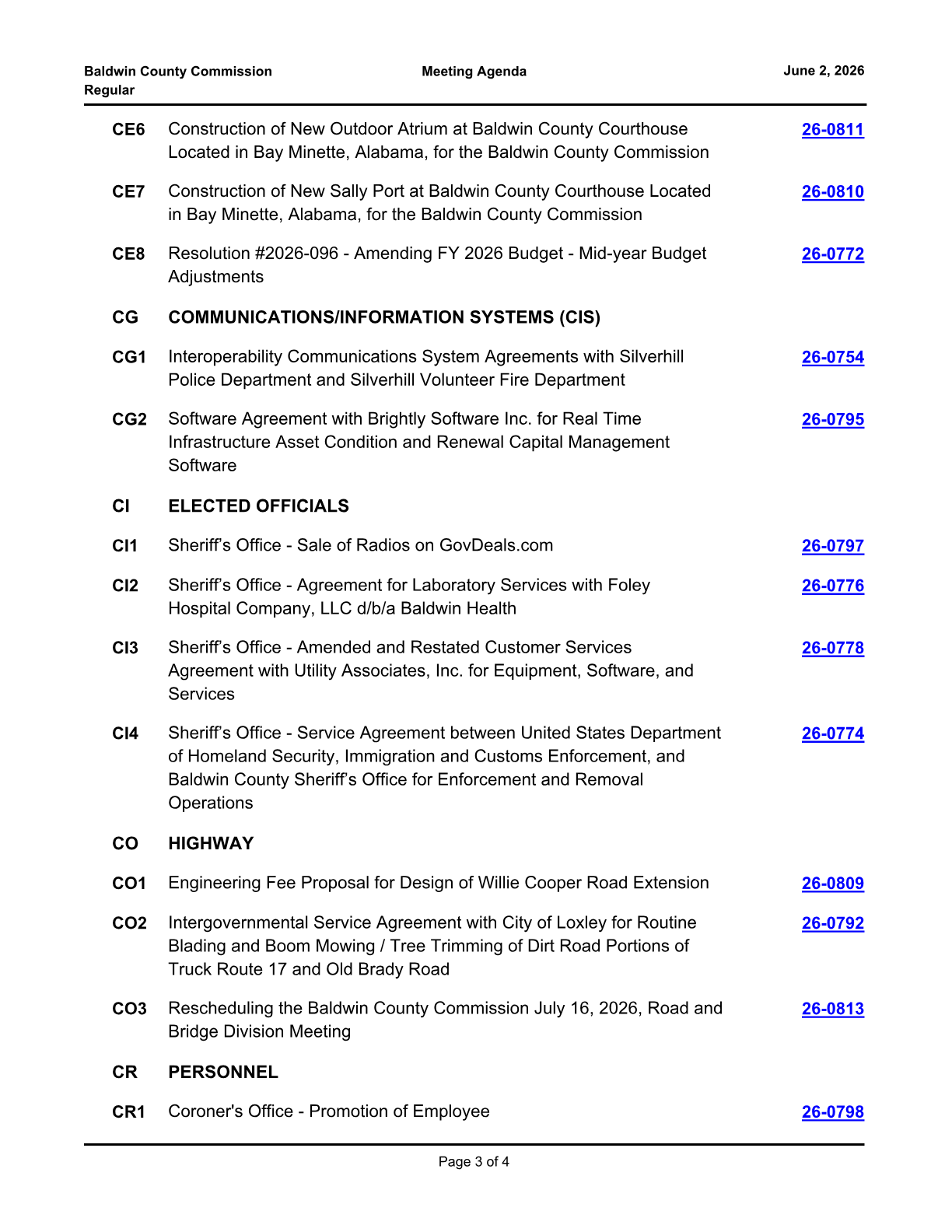
Agenda excerpt, June 2 Baldwin County Commission regular meeting, page 4 — item CI4 under CI Elected Officials.
The agreement, posted with the agenda item, covers "stipends, incentives, and/or reimbursable costs" owed to the Sheriff's Office for providing personnel to operations under the federal 287(g) program, which delegates certain immigration enforcement authority to local officers. According to the action record, Sheriff's Office officers are eligible for overtime reimbursement, and any funds received will be submitted to the County Commission to cover those overtime costs.
The agreement remains in effect for no more than 36 months unless both parties extend it, and either party may end it by giving written notice at least 60 calendar days ahead, unless both sides agree to a shorter period, the document states. The agreement does not state payment amounts; it is a fixed-rate agreement whose rates are specified on a separate federal form, subject to the availability of funds.
The June 2 action follows a step the commission took this spring. On March 17, the commission authorized Sheriff Anthony Lowery to enter a 287(g) Task Force Model memorandum of agreement between ICE and the Sheriff's Office (file 26-0382), according to county records. Under the task force model, designated local officers perform immigration enforcement activities approved in advance by ICE's Enforcement and Removal Operations division, the service agreement states. The March record lists quarterly equipment and information-technology stipends of up to $7,500 each per credentialed task force officer.
To be credentialed as task force officers, deputies must complete ICE-required initial and refresher training and pass the federal E-Verify employment-eligibility check, the agreement states. The agreement also provides that a participating task force agency will take on any case ICE designates, with Enforcement and Removal Operations approval, involving a person who was previously in Office of Refugee Resettlement custody, was subsequently released, and is unaccounted for.
Dozens of other Alabama law enforcement agencies have signed 287(g) agreements with ICE, including police departments in Baldwin and Mobile counties, Lagniappe reported in March. Sheriff Anthony Lowery told the newspaper then that he had pushed to focus the work on violent offenders. "Any violent offender, I don't care if you're here illegally or not, that needs to be addressed every day," he said.
Items on the consent agenda are grouped for a single vote and adopted together unless a commissioner asks to pull an item for separate discussion. The commission sets its consent agenda at the 9 a.m. work session that precedes the 10 a.m. regular meeting.