Baldwin County Commission to Take Up Jail Mental Health Cells, Publix Opioid Settlement and Watershed Roads Tuesday
Ahead of Tuesday's meeting: construction is already under way on mental health holding cells at the county's jail and juvenile detention center, with a small allowance up for approval; the commission would join an opioid settlement with Publix that Alabama has yet to announce publicly; and a $439,710 ADEM agreement targets two dirt roads washing into the Magnolia River watershed.
The Baldwin County Commission meets Tuesday, July 7, 2026, with an agenda that touches an ongoing federally funded project adding mental health holding cells at the county's two detention facilities, a resolution joining an opioid settlement with Publix Super Markets that the state has not yet publicly announced, and $439,710 in state grant money to stop two dirt roads from washing into the Magnolia River watershed.
Each item below sits in the meeting's batch of routine business — what the county calls its consent agenda — adopted in one vote, without discussion, unless a commissioner pulls an item for a closer look.
Mental health holding cells at both detention centers
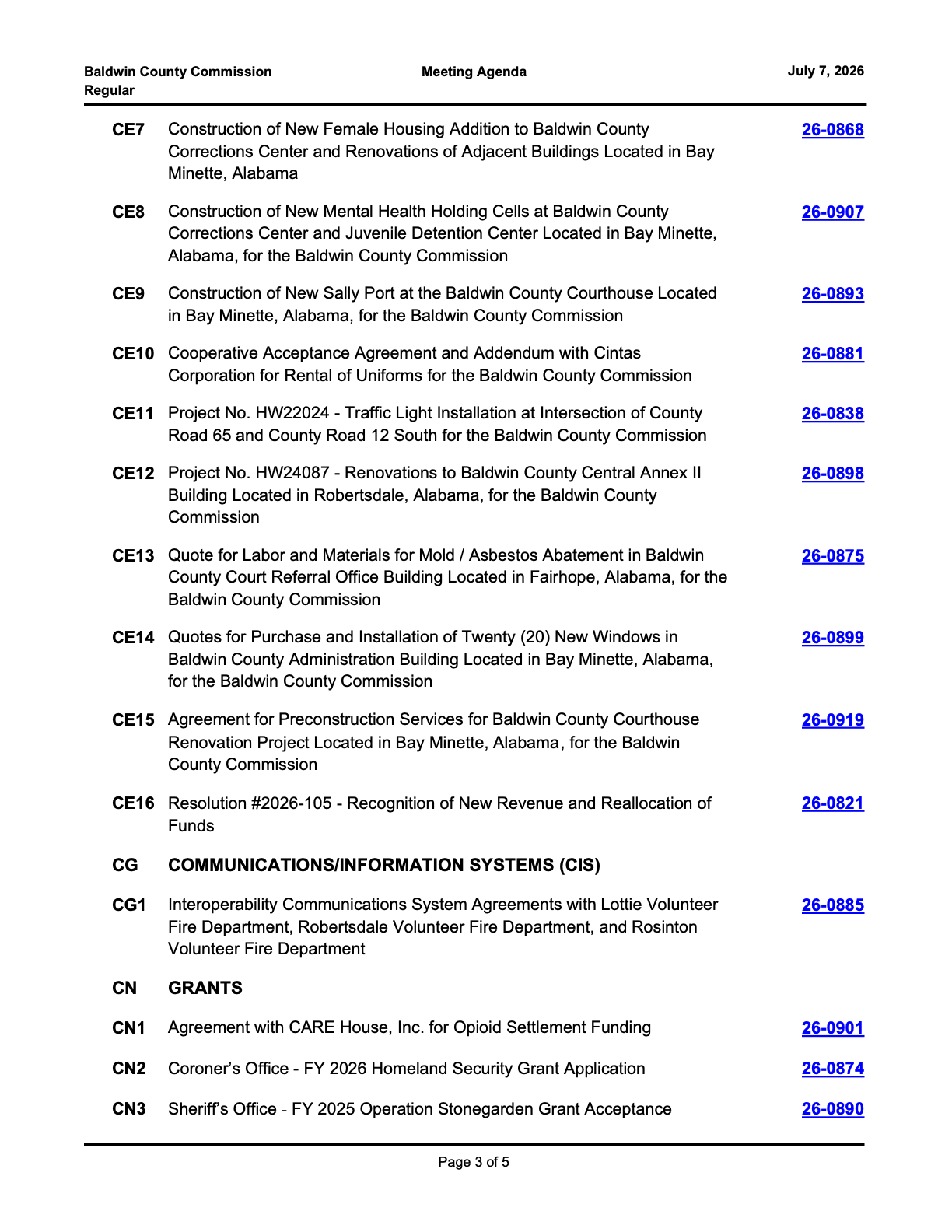
Agenda excerpt, Jul 7 meeting, page 4.
Construction is already under way on dedicated mental health holding cells at the Baldwin County Corrections Center and the Baldwin County Regional Juvenile Detention Center, both in Bay Minette. Tuesday's item, CE8 (file 26-0907), is a routine step within that project: Allowance Authorization No. 5, a $13,061.67 fire panel repair paid from the project's $200,000 contingency allowance, with no change to the contract amount. After this authorization, just under $100,000 of the contingency remains.
The project itself is larger than Tuesday's line item suggests. According to the item's background summary and prior commission actions, the commission approved the project in December 2023 and awarded the construction contract in August 2024 to low bidder Tindle Construction, LLC, at $3,900,000 with a 240-day schedule, following a 2022 feasibility study by PH&J Architects that proposed converting the Corrections Center's Holding Areas L, M and N. The work is funded through the American Rescue Plan Act, the 2021 federal pandemic-relief law. Then-Sheriff Huey "Hoss" Mack told 1819 News in August 2024 that the project would reconfigure 12 jail cells into monitored mental health cells for men and women — space that separates individuals in acute crisis from the general population while they await evaluation or transfer, a practice that has become more common in county detention systems.
The item sits alongside other construction activity on the county's Bay Minette campus. CE9 (26-0893) would authorize a similar allowance — No. 6 in the same ARPA program — for a new sally port at the Baldwin County Courthouse. And CE7 (26-0868) asks the commission to accept a partial certificate of substantial completion, dated June 26, 2025, for the booking and intake, kitchen and central-control areas of the new female housing tower at the Corrections Center — part of a separate, much larger jail expansion built by Wharton-Smith, Inc. and financed by county borrowing rather than pandemic-relief funds, which local media have reported at roughly $65 million.
Joining the Publix opioid settlements — and routing money already in hand
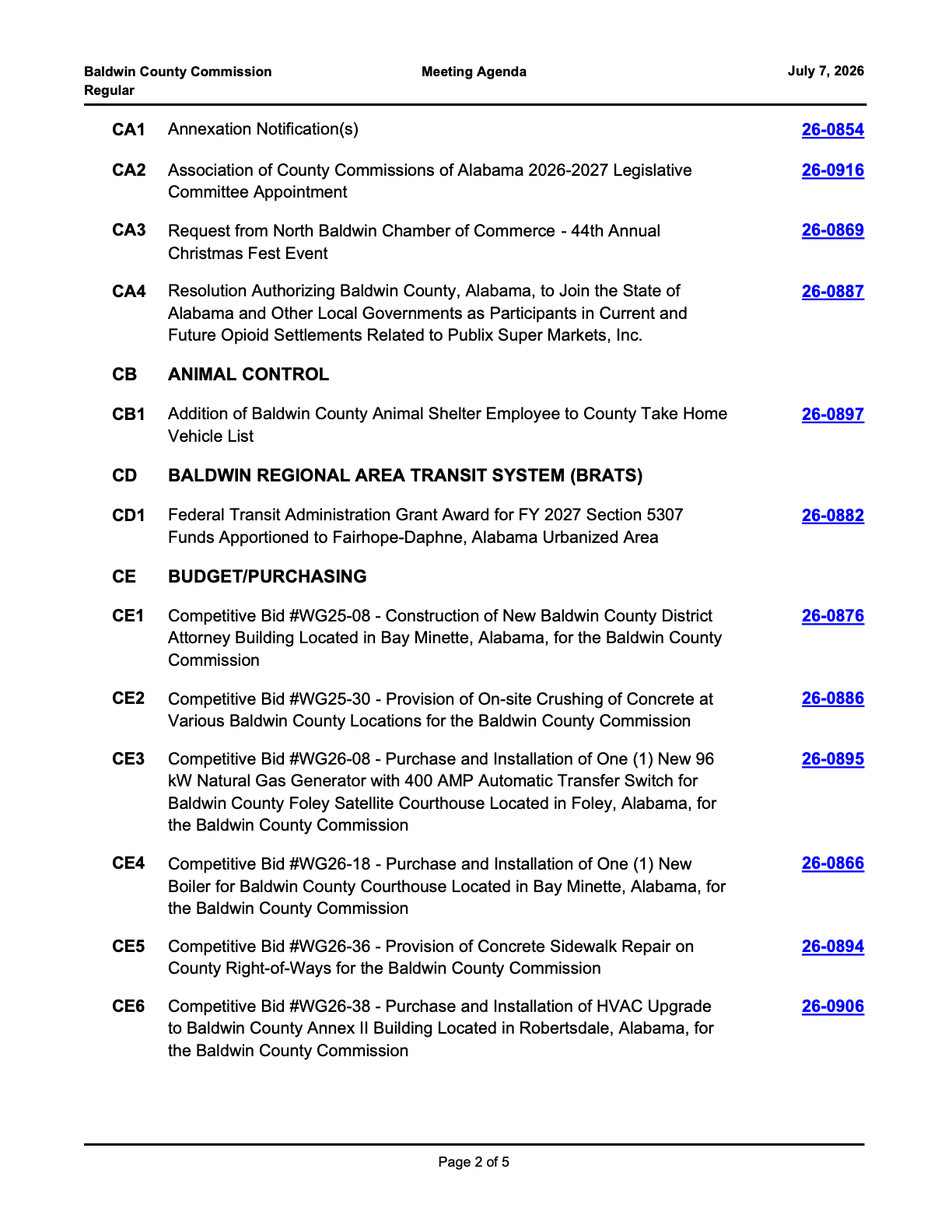
Agenda excerpt, Jul 7 meeting, page 3.
Item CA4 (file 26-0887) would adopt Resolution 2026-116, authorizing Baldwin County to join the State of Alabama and other local governments as participants in current and future opioid settlements related to Publix Super Markets, Inc. The resolution's recitals state that Alabama has entered into a settlement agreement with Publix that includes the claims of the state's local governments, and that the state has presented local governments a sign-on agreement. As of this article's publication, no announcement of a Publix settlement appears on the Alabama attorney general's website, and no dollar figures have been made public — the county resolution itself contains none.
Publix has been among the last major pharmacy defendants without a national opioid settlement. The company settled the bellwether case brought by Cobb County, Georgia, in July 2025 — county commissioners there approved a $5 million settlement, the Atlanta Journal-Constitution reported — and Metro Nashville filed a new suit against the chain as recently as May 2026. Tuesday's resolution is Baldwin County's fifth such sign-on since 2024, following identical resolutions for settlements involving Cardinal Health and Cencora, Kroger, Purdue Pharma and the Sackler family, and a group of remaining defendants this March. The county's opioid litigation dates to a civil complaint it authorized in January 2018.
A related item, CN1 (file 26-0901), would direct settlement money already in hand toward a local recipient: an agreement with CARE House, Inc., the nonprofit that operates the Baldwin County Child Advocacy Center, providing up to $150,000 a year in quarterly reimbursements for forensic interviews, trauma-focused therapy and family advocacy serving children affected by caregiver opioid and substance misuse. The 12-month agreement is renewable at the commission's discretion and follows the application-based Opioid Settlement Funding Program the commission adopted in May. The county's earlier direct spends from settlement funds include a $70,600 opioid-awareness media campaign approved in August 2025 and supplements to AltaPointe Health's crisis response team.
State help for eroding roads in the Magnolia River watershed
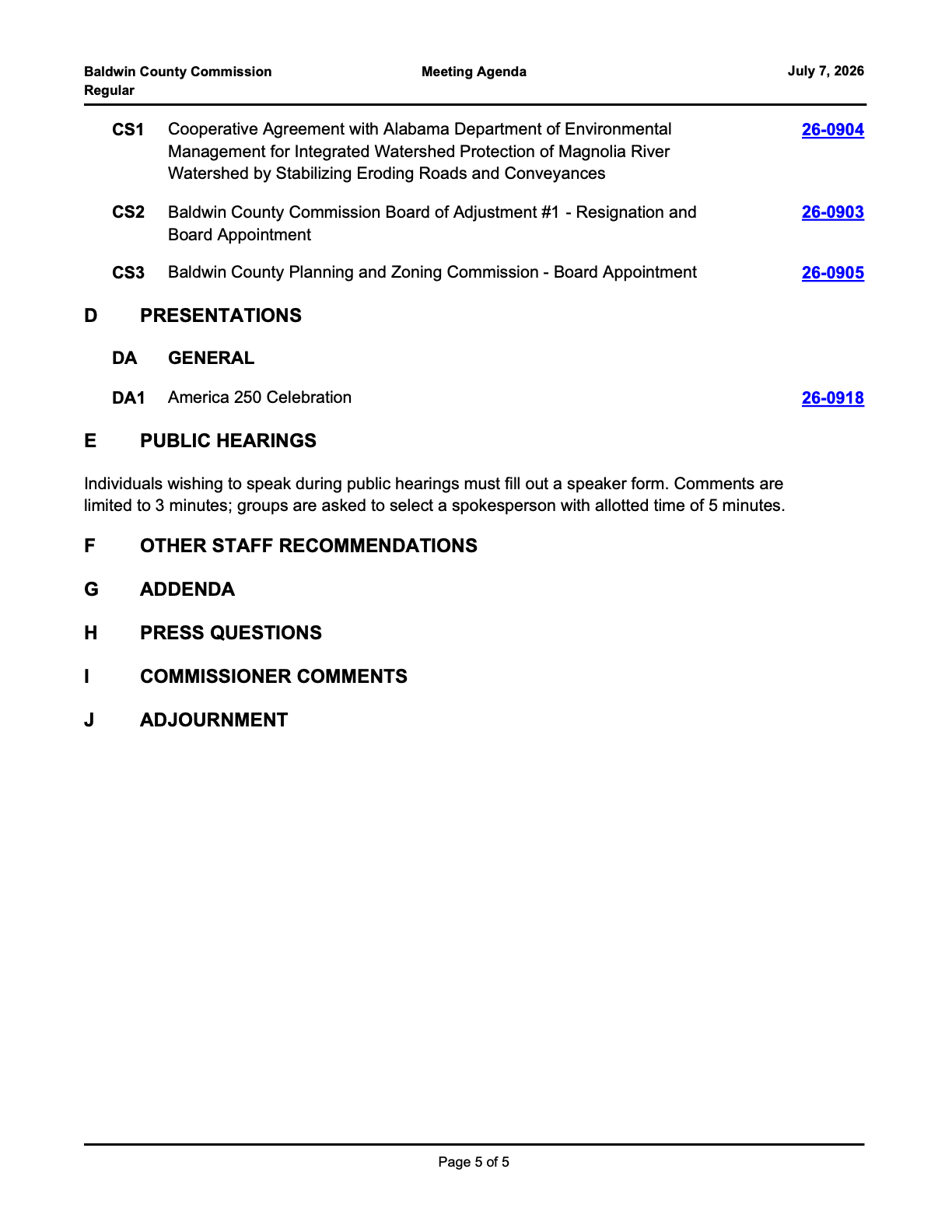
Agenda excerpt, Jul 7 meeting, page 6.
Item CS1 (file 26-0904), filed under Planning and Zoning, is a cooperative agreement with the Alabama Department of Environmental Management to stabilize Norris Lane and Hartung Road with gravel and construct bioswales — vegetated channels that slow and filter stormwater — under what the item calls an "integrated watershed protection" effort. The grant provides $439,710, matched by $331,136 in county in-kind labor and equipment with no cash outlay, and the agreement runs from July 7 through September 30, 2026.
The two dirt roads border turf grass farms, and according to the item's background summary, stormwater running off the sod operations regularly overwhelms them — sending eroded sediment into Weeks Creek, a tributary of the Magnolia River. The river has been designated an Outstanding Alabama Water since 2009, and the 2017 Weeks Bay Watershed Management Plan identifies unpaved dirt roads as a leading sediment source in the watershed, listing Norris Lane among six priority roads; the Magnolia River subwatershed carries more unpaved road mileage than any other in the Weeks Bay system.
The meeting
The commission's four district representatives — James E. Ball of District 1, Matthew P. McKenzie of District 2, Billie Jo Underwood of District 3 and Charles F. Gruber of District 4 — will cast the votes. Items approved in the batch vote take effect immediately — no second vote is needed. The commission meets at 10 a.m. Tuesday in the County Commission Meeting Chambers at 322 Courthouse Square in Bay Minette, following a 9 a.m. work session where commissioners set the meeting's final agenda.