Bay Minette Council Considered Hemp Retail License for Downtown D'Olive Street Business
Among the items on the City Council's May 4 agenda was Resolution 0426-09, which would approve an application for a 700 Specialty Retailer of Consumable Hemp Products License for Bay Minette Liquor Wine Cigar at 712 D'Olive Street.
When the Bay Minette City Council met on Monday, May 4, 2026, the consideration-of-resolutions section of its agenda included an application for a state-issued specialty-retailer license to sell consumable hemp products at a downtown D'Olive Street business.
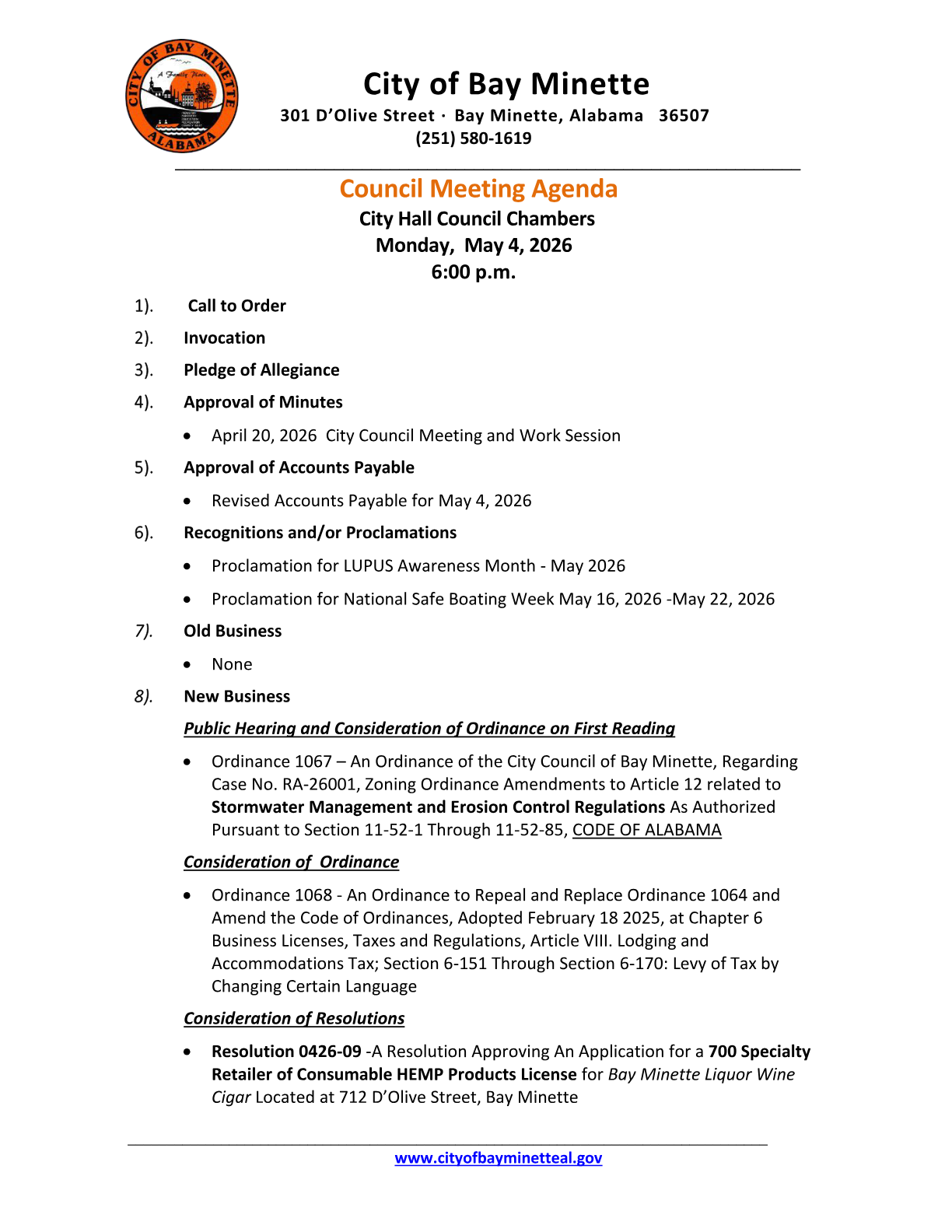
Excerpt from the May 4, 2026 Council Meeting agenda — page 2.
Per the agenda, Resolution 0426-09 was titled "A Resolution Approving An Application for a 700 Specialty Retailer of Consumable HEMP Products License for Bay Minette Liquor Wine Cigar Located at 712 D'Olive Street, Bay Minette."
What a "700 Specialty Retailer of Consumable Hemp Products License" is
Under Alabama's licensing framework administered by the Alabama Alcoholic Beverage Control Board, the 700-series license is the state license category for retailers selling consumable hemp products — items such as CBD-infused beverages, edibles, and other products derived from hemp containing no more than 0.3 percent THC.
Alabama tightened its regulatory regime around consumable hemp products in recent legislative sessions, requiring retailers to hold the state-issued license, restricting sales to customers 21 and older, and capping the amount of THC permitted in any single serving. Municipalities are typically asked to certify that an applicant's proposed location complies with local zoning and is not within a buffer of schools, churches, or other restricted uses, before the state license is finalized.
The agenda title indicates the council was being asked to approve the application — the municipal step in the process — for the location at 712 D'Olive Street, the address of an existing retailer whose name on the agenda is given as "Bay Minette Liquor Wine Cigar."
The agenda does not list the applicant's full legal name, the type of consumable hemp products that would be sold, or the date the license, if approved by the state, would take effect.
Why the license exists: Alabama's hemp law
Bay Minette's vote on the license came because of a state law that took effect just months earlier. Until 2025, Alabama had no state-level licensing regime for consumable hemp products — anyone could sell them, and a wide range of CBD and low-dose THC products were available at gas stations, convenience stores, and bespoke CBD shops across the state.
That market grew out of the 2018 federal Farm Bill, which legalized hemp nationally and defined it as cannabis containing no more than 0.3 percent THC by dry weight. Alabama followed in 2019 with SB225, which aligned state law with the federal definition and authorized the Alabama Department of Agriculture and Industries to regulate hemp production. SB225 covered farming and processing — not retail sale of finished products. That gap, combined with the Farm Bill's silence on finished-good regulation, is what produced the unregulated retail market that grew over the following six years.
In 2025, the Legislature closed the gap. House Bill 445, sponsored by Republican Rep. Andy Whitt of Harvest (District 6), passed the spring 2025 session and was signed by Governor Kay Ivey on May 14, 2025. The law rolled out in two stages:
- July 1, 2025: smokable hemp products — flower, pre-rolls, vapes, hemp cigars — became illegal to sell or possess in Alabama, with violations classified as a Class C felony.
- January 1, 2026: the new retail licensing regime took effect. Retailers who want to sell consumable hemp products must hold a license issued by the Alabama Alcoholic Beverage Control Board, the same agency that licenses alcohol sales.
Under the new framework, the ABC Board recognizes three license categories. Specialty retailers can sell the full range of consumable hemp products — beverages, edibles, and topical or sublingual products — and must operate as a dedicated retail establishment restricted to patrons 21 and older. Retail food stores (grocery stores) can sell only consumable hemp beverages. Pharmacies can sell only topical or sublingual products. Convenience stores and gas stations cannot obtain any of the three licenses.
The Bay Minette agenda item describes the application as a 700 Specialty Retailer of Consumable HEMP Products License — the specialty-retailer category, the only one that permits selling the full product range at the location.
Other provisions of HB445 the new license carries with it: a cap of 10 milligrams of THC per serving and 40 milligrams per package on edibles and beverages, a 10 percent state excise tax on hemp sales, a $25,000 surety bond requirement, certificate-of-analysis record-keeping, monthly gross-sales reporting to the state, a prohibition on direct-to-consumer online sales and deliveries, and a prohibition on on-premises consumption and product tastings.
The law is being challenged
In late June 2025, four hemp companies filed a federal lawsuit against Governor Ivey and Attorney General Steve Marshall, arguing that HB445 conflicts with the 2018 Farm Bill's protections for hemp commerce. The suit cites the U.S. Constitution's Supremacy Clause and Commerce Clause, with particular focus on the smokable-hemp ban and the THC-content caps. As of this writing, those challenges remain pending and the law remains in effect — local license approvals like Bay Minette's are proceeding under the law as written.
The May 4 agenda also took up Ordinance 1067 amending the city's stormwater management and erosion-control zoning requirements, Ordinance 1068 amending the city's lodging-tax ordinance, and a mayoral update on the disposal of four surplus Dodge Charger police vehicles, which were to be donated to the Prichard Police Department. The full agenda is on the city's May 4 agenda PDF.