After 17 Months of Frozen Development, Fairhope's New Growth Rules Face Their Hearings Monday
Nine ordinances rewriting Fairhope's zoning code — a townhouse density cap, the first impervious-surface limits in every neighborhood, tighter apartment and PUD rules, and a bigger allowance for mixed-use downtown — get public hearings July 13, with individual votes set for July 27. They implement the 2024 Comprehensive Plan and are what the city's residential moratorium has been waiting on.
Fairhope has spent 17 months holding new residential development at arm's length while it rewrote the rules of growth. Monday night, the rewrite finally lands: the City Council opens public hearings on nine ordinances that would cap townhouse and apartment density, put the first-ever limits on paved-over ground in every single-family neighborhood, strip houses out of the business districts — and, in one deliberate exception, invite bigger mixed-use buildings downtown.
The hearings begin at the council's 6 p.m. regular meeting July 13 at the Fairhope Municipal Complex, 161 N. Section Street, following a 4:30 p.m. work session. The votes come two weeks later: Councilman Jimmy Conyers told Gulf Coast Media the council will take up each ordinance individually at its July 27 meeting.
Why the city froze development to write this
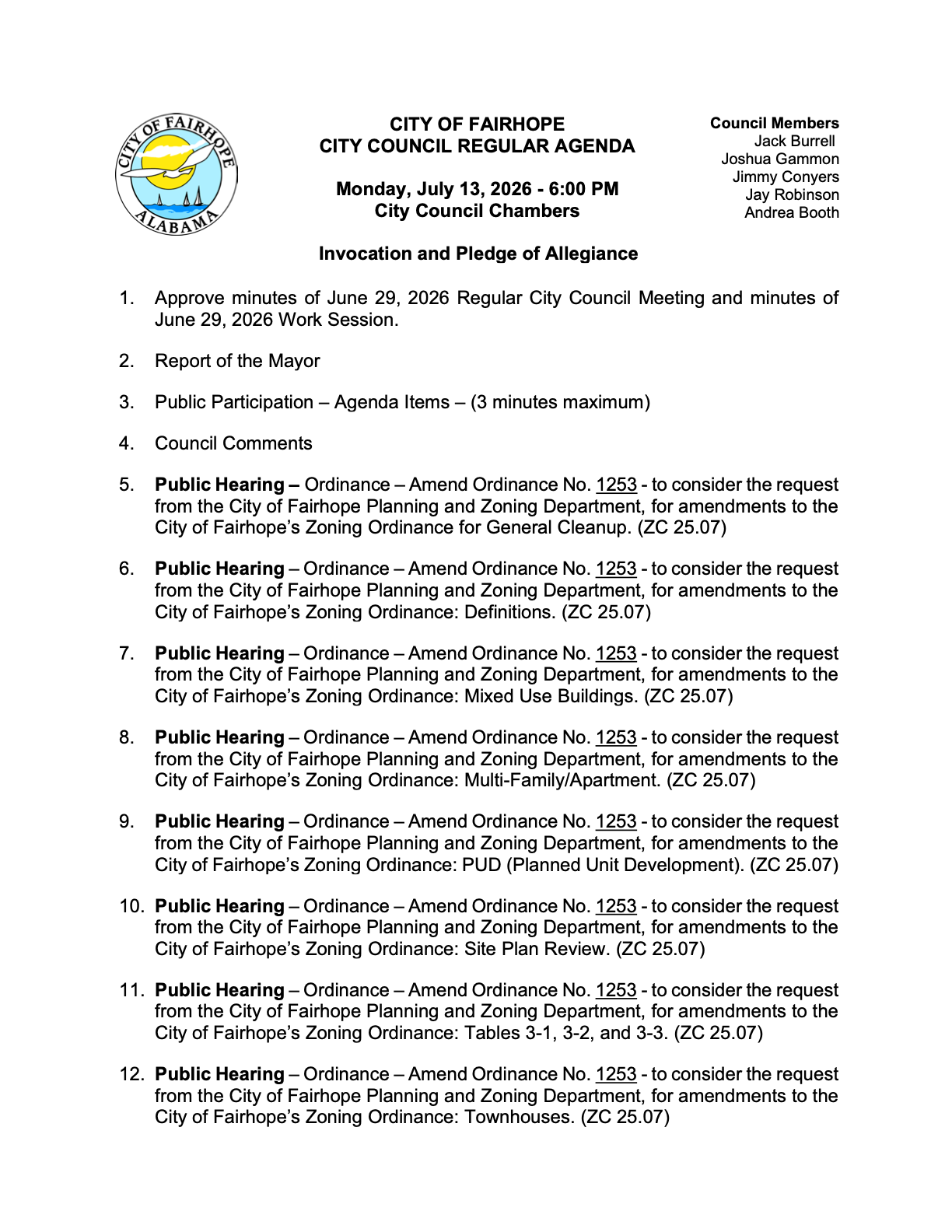
Agenda excerpt, Jul 13 council meeting — nine of the hearings carry the same case number, ZC 25.07.
The nine ordinances implement the city's 2024 Comprehensive Plan — the RESTORE Act-funded "Plan Fairhope" effort begun in 2021 and adopted by the Planning Commission in November 2024 — and they are what Fairhope's development moratorium has been waiting on. Since February 2025, the city has suspended applications for most projects of three or more homes inside the city limits, an ordinance the council has extended repeatedly — most recently on June 29, unanimously, through Aug. 17. "We want smart growth. We do not want no growth," Councilman Jack Burrell said when the freeze was first adopted, according to Gulf Coast Media.
The pressure behind all of it is arithmetic. Fairhope counted 25,731 residents in 2024 census estimates — up 13.3% since 2020 — in a metro area that ranks among the fastest-growing in the country, and the Public Affairs Research Council of Alabama notes Baldwin County holds four of the state's five fastest-growing cities. City officials have paired the moratorium with catch-up work on water and sewer capacity; "We're trying to catch up on infrastructure. I don't think that we've caught up enough," Burrell told Lagniappe this month.
The zoning ordinance itself dates to 2005, and planning staff wrote in a February memo that it has seen "only piecemeal edits over the last 20 years," with a fuller overhaul budgeted beyond this first round of amendments.
What would actually change
The package tightens nearly every residential dial:
- Townhouses get a net-density cap of 7 units per acre — with streets, wetlands and stormwater ponds excluded from the math — plus a 3,600-square-foot minimum lot per unit, 20-foot front and 35-foot rear setbacks, a secluded 400-square-foot rear yard for every unit, and a requirement that all parking load from the rear by alley or internal drive, no space more than 100 feet from the door it serves.
- Apartments get their own standards section for the first time: minimum one-acre sites with 200 feet of street frontage, buildings capped at two stories and 30 feet, density capped at roughly 4.5 units per acre, two parking spaces per unit plus visitor parking.
- Every single-family district gets a first-ever impervious-surface cap — between 30% and 45% of the lot, depending on the district — limiting how much of a yard can become roof, driveway and patio, with credit for surfaces that drain like natural ground.
- Planned unit developments, the flexible zoning that produced many of Fairhope's subdivisions, would require at least three acres and no more than three units per acre gross.
- The business districts lose housing: single-family homes, duplexes and townhouses come off the permitted-use tables in the B-1 and B-2 districts, and townhouses in B-4.
- Downtown goes the other way. A new mixed-use building section lets projects in the central business district overlay rise three stories and 40 feet with a floor-area ratio of 225% and roughly 12 units per acre — but requires at least 75% of the ground floor to be commercial, up from 50% today. Outside downtown, mixed-use buildings are held to two stories and suburban-scale density.
- The package also deletes the Village Districts — an option on the books for about 20 years that, per the staff memo, was never used — creates two new recreation districts for parks and preserves, and adds definitions that do quiet work, including a rule that a dwelling unit "shall have no more than one electrical meter."
Two years of pushback shaped it
The package has been through the wringer. The Planning Commission recommended it unanimously in September 2025 — over an objection from a planner at Goodwyn Mills Cawood, who warned the amendments "may kill multi-family developments," according to the minutes. When the original single-ordinance version reached the council in October 2025, architect Mac Walcott opposed the height limits, downtown residential restrictions and impervious caps — "landowners are getting less use of their property," the minutes record — and the council let it lie over. A February hearing at the council's regular meeting drew a dozen speakers, all opposed — several against extending the housing removal into two more business districts, a piece Planning Director Hunter Simmons subsequently declined to recommend. A three-hour special meeting followed in April.
The revisions moved real numbers: the downtown density cap was loosened from one unit per 7,000 square feet to one per 3,630, the floor-area ratio rose from 200% to 225%, and the building-height amendments were pulled out for separate handling. Asked at the February meeting what worried him if the package failed, Simmons answered, according to the minutes: "to lose the Fairhope charm and character."
Also Monday
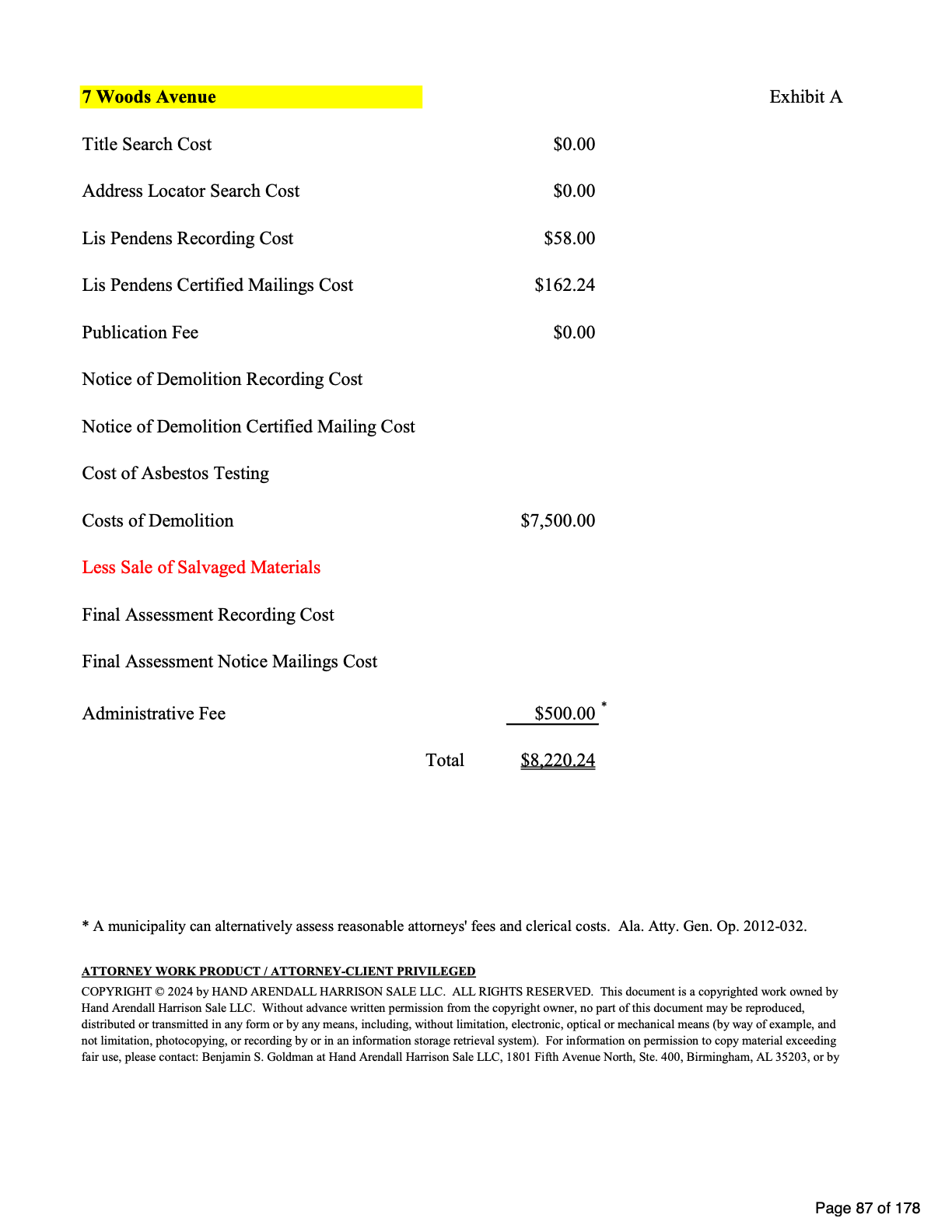
Exhibit A itemizing the demolition costs assessed against 7 Woods Avenue — Jul 13 packet.
Two smaller hearings share the agenda. The council will consider assessing $8,220.24 against 7 Woods Avenue to recover the cost of demolishing a building it had declared "unsafe to the extent that it was a public nuisance" — $7,500 for the demolition plus fees and recording costs, with foreclosure authorized if the bill goes unpaid. And a housekeeping rezoning (ZC 26.05) would shift two small lots holding Thomas Hospital's backup generators from residential to business zoning as they're combined into the hospital campus; the Planning Commission recommended it 9-0, and staff note the surrounding Northrop Avenue homes keep their residential zoning. At the 4:30 p.m. work session, the council is also set to discuss dedicating land for a sewer lift-station project.
For residents who want a say in the new rulebook, Monday is the hearing; July 27 is the vote.