To Court Boutique Hotels and Upscale Dining, Gulf Shores Weighs 20-Year Tax Rebates
Two proposed investment programs would let the city rebate up to half of new sales, property and lodging taxes to developers who build restaurants, hotels, mixed-use projects and entertainment venues in the Beach Walking District and Waterway Village area. Any rebate would flow only after a project is finished and already generating new tax revenue for the city.
The Gulf Shores City Council will take up two proposed economic-development incentive programs — the Beach Walking District Area Investment Program and the Waterway Village Area Investment Program — at its 4 p.m. work session Monday, July 6, 2026.
Both districts already exist. Waterway Village is a mixed-use overlay district the city has developed along the Gulf Intracoastal Waterway, where a federal grant is funding a new pedestrian bridge and two public plazas to connect its two sides. The Beach Walking District, along West 1st Avenue near the public beach, grew out of the city's "Vision 2025" strategic plan and has been built out in phases of new roads, sidewalks, landscaping and stormwater upgrades. The two proposed programs would layer private-development incentives onto those existing public efforts.
Both programs are built around the same basic mechanism: a developer completes a qualifying project, the project starts generating new tax revenue for the city, and only then does the city rebate the developer a share of that new revenue. The staff report is explicit that the city will not put up any startup capital or construction assistance and will not guarantee any developer's construction debt or other obligations.
Under the proposed structure, qualifying projects could receive a rebate of up to 50% of new city sales tax, incremental city property tax or city lodging tax for up to 20 years. The Beach Walking District program lists the applicable city rates as a 3% sales tax, 5 mills of incremental property tax and a 10% lodging tax. A blended rebate would also be available for mixed-use or "major catalytic" projects.
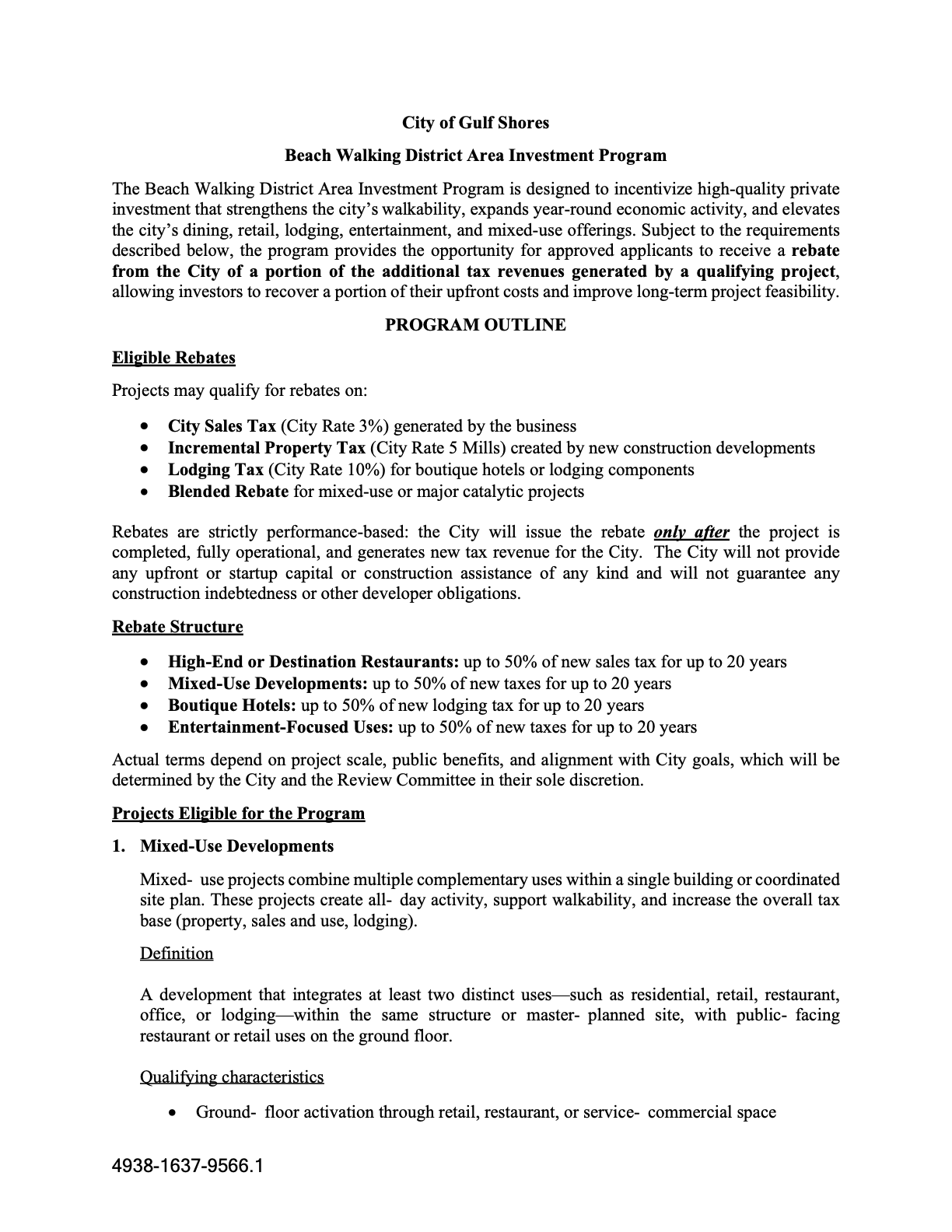
The Beach Walking District Area Investment Program outline, showing the rebate structure and the city sales, property and lodging tax rates — Jul 6 work session packet.
Gulf Shores has offered this kind of incentive before. For the Embassy Suites hotel and conference project on West Beach Boulevard, the city agreed to rebate 42% of the development's new sales tax for the first three years and 35% each year after, up to $6.5 million — to offset the cost of adding conference and meeting space.
The programs target five categories of development: high-end or destination restaurants, boutique or specialty retail (limited to the Waterway Village area), mixed-use developments, high-end or boutique hotels, and entertainment-focused venues. The packet lays out detailed qualifying characteristics for each. Mixed-use projects, for example, would need to combine at least two distinct uses — such as residential, retail, restaurant, office or lodging — with retail or restaurant space activating the ground floor, and would be capped at 12 stories, with a stated preference for buildings under 10 stories. Boutique hotels would typically need 50 rooms or more, ground-floor activation such as a restaurant or lobby lounge, and a brand within the STR Upper Upscale chain scale or higher, or an independent concept meeting the same standard.
Developers would not simply qualify by meeting those definitions. The packet describes a two-step approval process. First, an applicant submits a formal application to a Review Committee, which scores projects on factors including capital investment level, job creation for high-wage, year-round positions, public improvements such as parking, plazas and sidewalks, architectural quality, local ownership or operator involvement, sustainability features, and year-round operation. Higher-scoring projects could receive higher rebate percentages or longer terms. Applications must include financing details, proof of equity or funding sources, developer track record, market studies, design and engineering plans, construction cost estimates, and revenue projections for the city — plus a demonstrated financing gap that the rebate would help close. The packet notes that applicants are "encouraged not to submit Applications until all requested and relevant information has been obtained."
If the Review Committee approves an application, the developer and the city would then negotiate a formal development agreement spelling out performance benchmarks. A project would have to be completed and meet those benchmarks before any rebate activates, and the developer would have to stay in compliance with operational standards and other terms for the rebate to continue. Any completed development agreement would still require City Council approval, which the packet ties to Amendment No. 772 to the Alabama Constitution of 2022, as amended.
The packet includes a disclaimer stating the notice does not constitute an offer, and that both the Review Committee and the City Council retain sole discretion to approve or reject any application or project. Approved projects would still need to meet all city building, zoning and design requirements. The attachments accompanying the item are the outlines for the Waterway Village Area Investment Program and the Beach Walking District Area Investment Program, along with a blank application form. No specific applicant or proposed project is identified in this portion of the agenda item, and the packet lists no related issues.