A $16.2 Million Effort to Save Daphne's Creeks — and a Busy June for Fire, Police and Home Building
City councilmembers heard Monday how the Mobile Bay National Estuary Program has rebuilt nearly 2.8 miles of eroding streambank in the D'Olive Watershed since 2012, cutting an estimated 28,662 tons of sediment per year out of the bay — work that in 2020 got Joe's Branch off Alabama's impaired-waters list and in 2013 won a presidential coastal-restoration award. The same evening, two city committees reviewed a busy June for the fire department — 444 calls — and $8.6 million in new building permits.
Daphne's City Council heard Monday night that a 14-year, $16.2 million campaign has rebuilt nearly 2.8 miles of eroding creeks in the D'Olive Watershed — the 8,739-acre drainage the city shares with Spanish Fort and Baldwin County — and now keeps more than 28,000 tons of sediment out of Mobile Bay each year.
The Mobile Bay National Estuary Program's briefing, delivered at a 6 p.m. work session, was informational; no vote was taken and no resolution was on the agenda. Any council follow-up — a cost-share, an easement, a construction contract — would land on a later meeting; the next regular council meeting is set for Monday, Aug. 3, preceded by the Public Works Committee the same evening.
The D'Olive watershed: $16.2 million and 2.8 miles of rebuilt creek
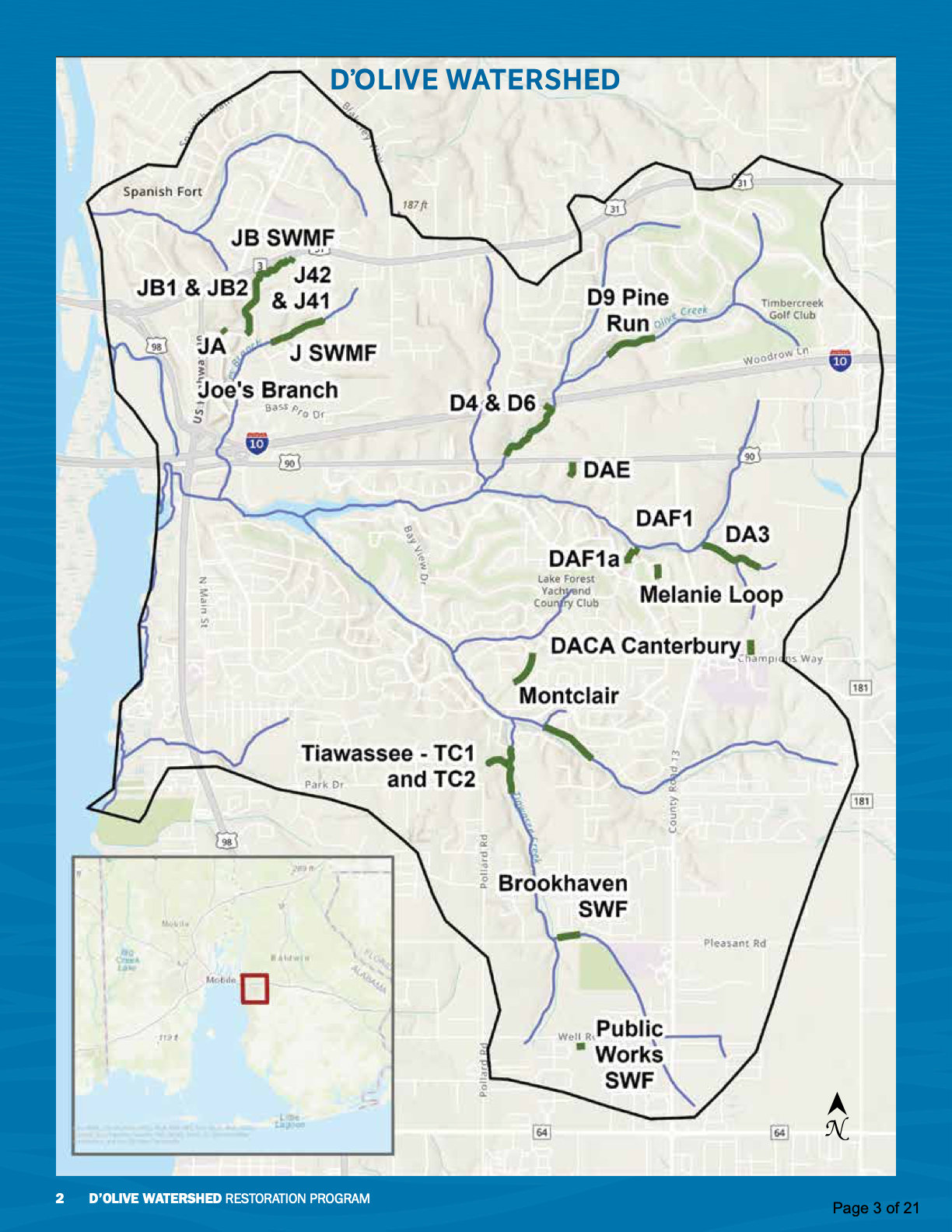
Map of the D'Olive Watershed's restoration sites — Jul 13 work session packet.
The numbers in the briefing packet tell a long story. Since 2012, the program and its partners have rebuilt nearly 15,000 linear feet — about 2.8 miles — of eroding streambank, work the packet says now keeps 28,662 tons of excess sediment out of Mobile Bay each year, along with about 91 tons of nitrogen and 26 tons of phosphorus. Total project costs stand at $16,202,554, with another $1,239,572 — about 7.6% of the funding — going to the estuary program's project delivery, plus $219,662 for monitoring.
The packet calls the watershed "the perfect storm of stormwater impacts": steep, rolling terrain, highly erodible soils, more than five feet of hard rain a year, and urbanized surfaces covering half its area. A 2010 assessment found that of the watershed's nearly 24 miles of streams, 2.2 miles were already substantially degraded, 3.9 more were actively degrading, and another 5.9 were at risk — slightly over half the total mileage. The single most dramatic moment came on April 29, 2014, when a historic rain pushed more than 3,700 cubic feet per second through four box culverts under I-10, cutting the channel 10 to 15 feet deep and shoving boulders hundreds of feet downstream.
There have been some measurable wins. In April 2020, the Alabama Department of Environmental Management removed Joe's Branch — which had carried some of the highest sediment loads, by drainage area, the Geological Survey of Alabama had ever recorded — from Alabama's Section 303(d) list of impaired water bodies. And in 2013, the D'Olive Creek project received the Coastal America Partnership Award, which NOAA describes as the highest coastal-restoration honor endorsed by the President.
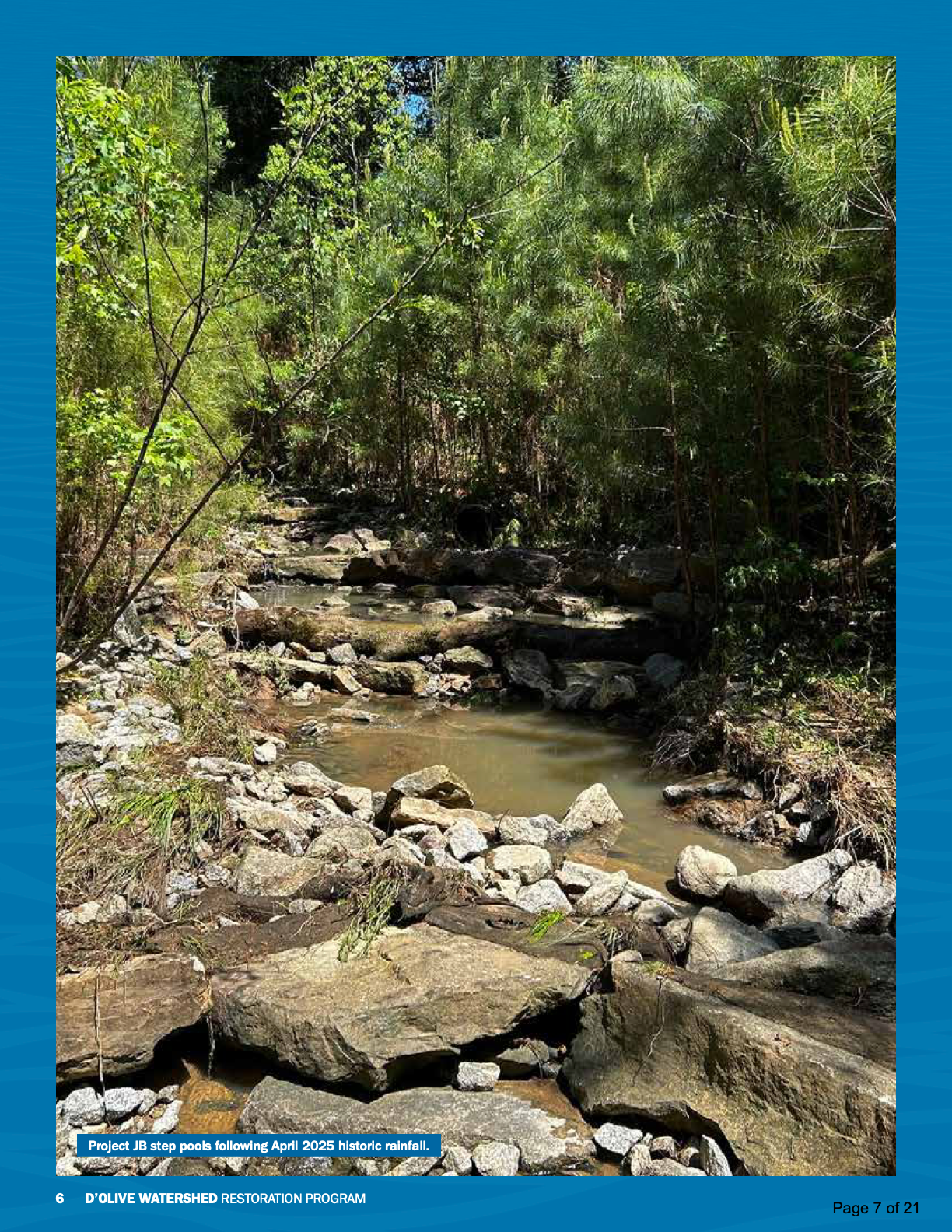
Project JB's step pools, photographed after the April 2025 historic rainfall — Jul 13 work session packet.
The costliest single project, a 2,714-foot rebuild between I-10 and U.S. 90 finished in 2016, ran $3,313,724. The most recent, 1,860 feet along Pine Run in the Timbercreek neighborhood, wrapped in December 2024 with adaptive management through May 2025. A Montclair Place project on 433 feet of Tiawasee tributary — total cost $617,654 — is under construction now.
June's public-safety numbers: 444 fire calls, 55 D-runs
Earlier in the evening, the Public Safety Committee, chaired by Councilwoman Jennifer Green, reviewed the departments' June figures.
The fire department answered 444 incidents in June — 247 of them medical calls, the largest share by far — with an average response time of 5 minutes, 36 seconds. That's a step down from May's 481 incidents, though the average response ran seven seconds slower than May's 5:29. Daphne gave mutual aid to neighboring departments seven times and received it three times, and firefighters logged 924 training hours.
The police report counted 231 incident reports, 116 arrests, 129 crashes and 143 citations for the month, plus 442 security checks. Officers ran 55 directed patrols — "D-runs" — with District 3 drawing the most at 15 and District 6 the fewest at 3. A motorist-compliance detail checked 2,279 vehicles, producing 45 warnings and 9 citations. Police Chief Brian Gulsby's report flagged that a recent celebration had drawn about 400 people to Joe Louise Patrick Park, and that a similar event could return the weekend of July 19, with no permits pulled as of the meeting.
An $8.6 million building month
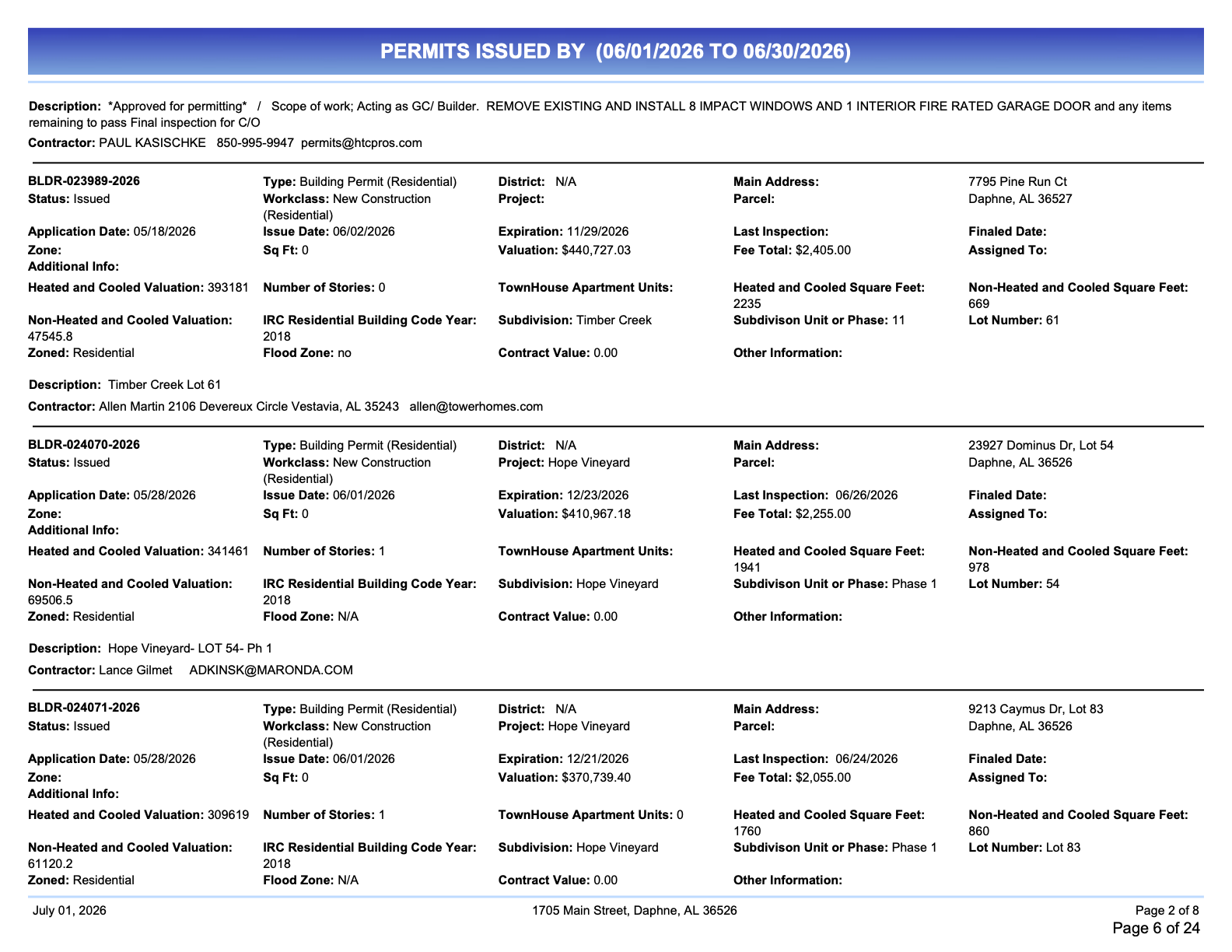
June permits-issued report, with Hope Vineyard's new-construction homes — Jul 13 committee packet.
Between the two, the Buildings & Property Committee took up a June construction report showing $8,607,290 in total permitted value across 20 permits — 19 of them residential new construction.
Hope Vineyard dominated the month with 13 new houses permitted by builder Maronda, and Tower Homes pulled three more on Patch Place Loop. The month's largest single home was an $856,806, 4,098-square-foot house at 106 Durnford Hill Court by Baker Clark Homes. The lone commercial permit was a $59,000 maintenance buildout at The Croft at Daphne on Pollard Road. The city's inspectors logged 394 total inspections for the month.
The committee also reviewed minutes from its June 8 meeting, where members voted unanimously — six present, Councilman Hughes absent — to support an ordinance updating the technical construction codes the city adopts by reference. The panel's next meeting is set for Aug. 10.